Buying Property in Spain Without Travelling: NIE, Power of Attorney and Remote Signing (2026)
Quick answer
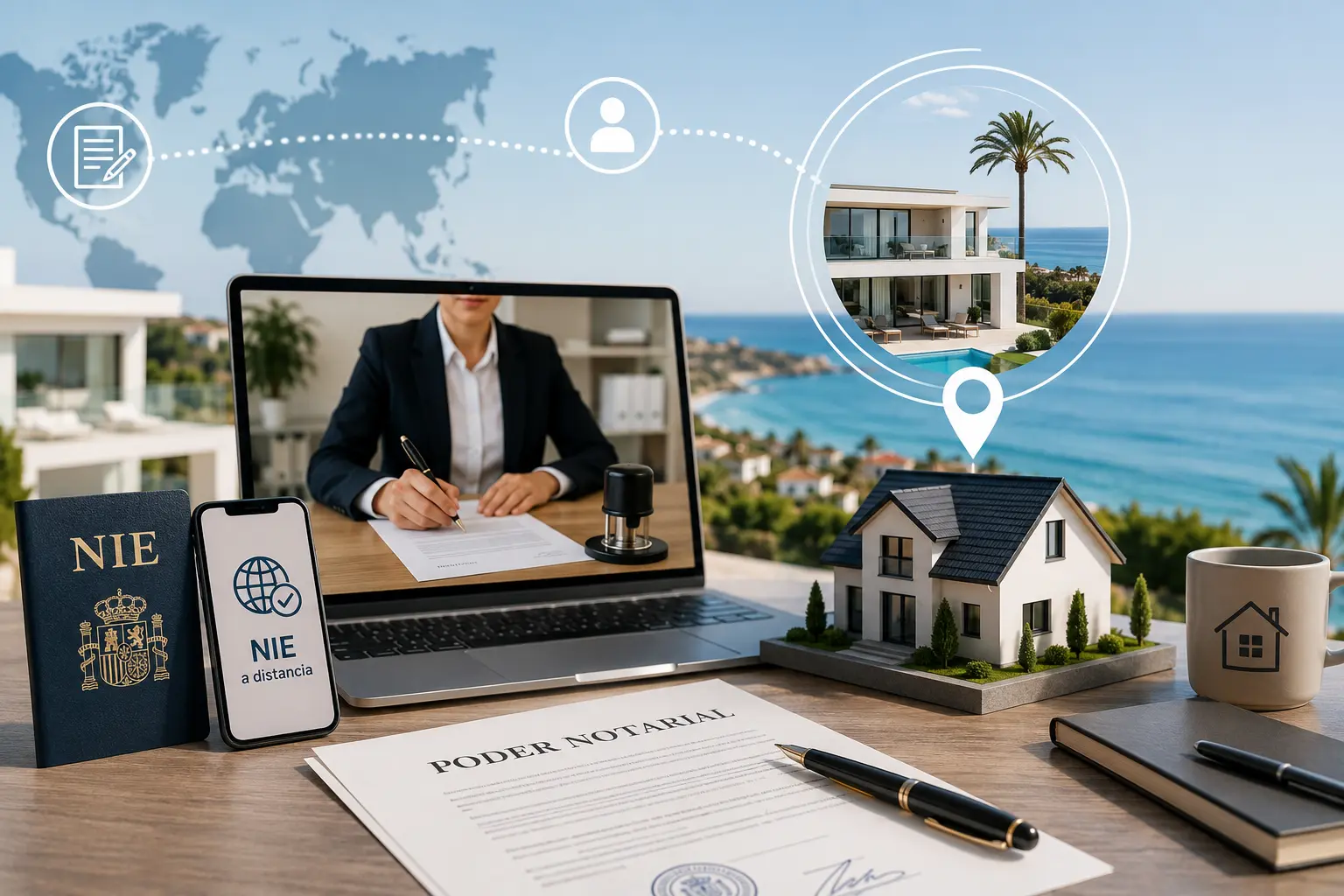
Yes, you can buy a property in Spain without setting foot in the country. The key is granting a specific power of attorney to your lawyer in Spain, who signs the deed before the notary on your behalf. You can grant it at a Spanish consulate in your country (no apostille or translation needed) or before a local notarial authority, with the Hague Apostille if your country is party to the Convention or with diplomatic legalisation if it isn’t. With that power, your representative can also obtain your NIE, apply to open a bank account and settle the taxes; whether the account is actually opened depends on the bank’s policy and its identification and source-of-funds checks. One point almost nobody explains: the purchase deed cannot be signed by videoconference — Law 11/2023 doesn’t include it among the acts that can be executed remotely — so either you attend, or your representative does.
TL;DR
- The power of attorney is the centrepiece. With a well-drafted specific power, your lawyer signs the deed, obtains the NIE and settles the taxes in your name.
- Consulate or local notary. At a Spanish consulate the document is valid in Spain directly; before a local notary you’ll need the Hague Apostille — or diplomatic legalisation if your country isn’t party to the Convention — and often a sworn translation.
- Neither the purchase nor the mortgage is executed by videoconference. Law 11/2023 does allow other remote acts, including specific powers of attorney. Both can be signed in person by a representative where the power is sufficient and, if you’re financing, the bank accepts the representation.
- The NIE can be applied for without coming, at the Spanish consulate in your country or through a representative with a power. Allow 2 to 6 weeks via a consulate, depending on the destination.
- Buying blind is the real risk. The formalities are what get solved remotely; the buying decision needs an in-person visit, a live video walkthrough or someone you trust on the ground.
A significant share of Costa del Sol purchases complete without the buyer being present on signing day. British, German, Nordic and Russian-speaking buyers who have visited the area once — or not at all — formalise the transaction from their own country through a representative. It is perfectly legal and fairly common, but it requires understanding what can be done remotely, what still needs someone physically present, and where the risks sit. This guide sets it out step by step. If you’re just starting, read it alongside our guide to buying property on the Costa del Sol.
What can be done remotely and what can’t
Here is the realistic picture of the process. Almost everything can be handled remotely; what can’t is solved with a representative:
| Step | Can it be done remotely? | How |
|---|---|---|
| Obtaining the NIE | Yes | Spanish consulate in your country, or a representative with a power of attorney |
| Opening a bank account | Depends on the bank | Online or through a representative, subject to identification, verification of the power and anti-money-laundering checks |
| Appointing a lawyer and due diligence | Yes | Instructed remotely; the lawyer reviews the Land Registry extract, charges and licences |
| Signing the deposit contract | Yes | Electronic signature or through a representative |
| Granting the power of attorney | Yes | Consulate, local notary with apostille or legalisation, or in certain cases by videoconference |
| Signing the purchase deed | Not remotely | Physical presence — yours or your representative’s — before a notary |
| Signing a mortgage | Yes, through a representative; not directly by videoconference | The power must include sufficient mortgage authority and be accepted by the bank. The borrower or their representative must also complete the notary’s prior transparency record |
| Paying taxes and registering | Yes | Handled by your lawyer or a gestoría |
The power of attorney: the piece that makes it possible
The power of attorney is the document authorising someone else — normally your lawyer in Spain — to act on your behalf. For a property purchase, the usual instrument is a specific power, limited to that transaction and to the necessary authorities: signing the deposit contract and the deed, applying for the NIE, opening a bank account, settling taxes and registering at the Land Registry. The more precise the wording, the better: your representative can only act within the authorities granted, and a poorly drafted power can derail the signing on the day itself.
A practical tip: have your lawyer in Spain draft it and send it to you before your appointment. That way the document contains exactly the authorities the Spanish notary will require, and you avoid having to repeat the whole process from abroad.
Spanish consulate or local notary: which suits you
| Spanish consulate | Local notary + apostille | |
|---|---|---|
| Validity in Spain | Direct, no further formalities | Requires the Hague Apostille (or legalisation) |
| Sworn translation | No (issued in Spanish) | Usually yes |
| Cost | Consular fee, generally low | Notary’s fees + apostille + translation |
| Timing | Depends on consular appointment availability, which can be slow | Appointments are usually easier to get |
| When to choose it | If you have a consulate nearby and aren’t in a hurry | If the consulate is far away or oversubscribed |
Two clarifications that prevent nasty surprises. The first concerns legalisation: the Hague Apostille works where the country in which you grant the power is party to the Convention; if it isn’t, you’ll need the corresponding diplomatic or consular legalisation. And in either case, apostilling and translating isn’t the whole story: the Spanish notary will also assess the sufficiency of the power and its functional equivalence to a Spanish public document.
The second is for British buyers: a UK Lasting Power of Attorney is not automatically equivalent to a Spanish power of attorney. It may be recognised if properly legalised or apostilled, translated where required, and the notary issues their assessment of sufficiency and equivalence — but acceptance isn’t guaranteed and also depends on the Land Registry or the bank. The safe route is to grant a power drafted under Spanish law.
What videoconference does allow (and what it doesn’t)
This is where many articles get it wrong. Since 9 November 2023, Law 11/2023 on notarial digitalisation has allowed a closed list of acts to be executed before a notary by videoconference, set out in article 17 ter of the Notaries Act. That list includes specific powers of attorney and certain revocations, along with company acts, commercial policies and the cancellation of security.
But the list does not include property purchases or mortgage loans, nor general or enduring powers of attorney. Nor can acts outside that list be ratified by videoconference. In practice, this means:
- Yes: in certain cases you can grant the specific power of attorney by videoconference through the notarial electronic portal, identifying yourself electronically.
- No: nobody can sign the purchase deed for you from a screen. Either you are at the notary’s office, or your representative is.
It’s also worth separating the legal possibility from practical availability: to use this route you need to access the notarial electronic portal, hold an accepted form of electronic identification, and have the notary consider it appropriate — they may prefer physical presence where they see risk or complexity. For a buyer resident outside Spain, therefore, the most predictable route remains a power granted at a consulate or before a local notary, duly legalised.
What if I’m buying with a mortgage?
That doesn’t necessarily force you to travel either, though it adds requirements. A mortgage deed cannot be executed by videoconference, but it can be signed by a representative, provided the power includes sufficient mortgage authority and the bank accepts the representation (each lender takes its own view, so confirm beforehand). In addition, Law 5/2019 on real estate credit agreements requires a prior notarial transparency record, at the latest the day before signing: the borrower or whoever represents them for these purposes must attend, which can also be done through a representative whose power the notary considers sufficient. If you’re financing, tell your lawyer from the outset so the power includes those authorities; you can see how financing works in our guide on getting the perfect mortgage.
The NIE without coming to Spain
The NIE is needed to complete the purchase properly, settle the taxes and register the property at the Land Registry. While exceptionally a deed might be authorised with the NIE still pending, its absence would prevent registration until remedied, so it’s best to obtain it before signing. You have three routes:
- At the Spanish consulate in your country of residence, by appointment.
- Through a representative in Spain holding a specific power of attorney for the procedure: the preferred option for anyone who can’t travel before the signing.
- In person in Spain, at an Immigration Office or authorised police station, by appointment.
The usual documentation includes form EX-15, your passport, evidence of the economic or legal reason (for example, the deposit contract or a buying instruction) and fee 790, code 012. The legal decision period is five working days, although in practice it tends to run to 5–15 days if applied for in Spain and 2–6 weeks via a consulate, depending on the country and workload. Note that, for consular applications, those five days don’t include appointment waiting times or processing between the consulate and the competent body, so the total is usually longer. Two useful points: the NIE number is personal and permanent (what may need updating is the certificate on which it appears), and holding one does not make you a resident or grant any residence or work permit.
Viewing the property without being there: what actually works
The formalities work well remotely. The decision is another matter, and it’s worth being honest: buying without seeing is where international buyers go wrong most often. What does work:
- A live video call, not an edited video. Ask to be shown the property in real time, with the chance to ask questions and have them open windows and cupboards or go up to the roof terrace.
- The surroundings, not just the flat. Ask for a walk along the street, the access, the noise at different times, and the real distance to the beach, supermarket or school.
- A virtual tour and a dimensioned floor plan to understand the layout and real floor areas, beyond wide-angle photography.
- An independent survey if it’s a resale: damp, installations, windows and doors, and the condition of the building.
- Full legal due diligence. Land Registry extract, charges, licences, community debts and planning status, reviewed by your lawyer before the deposit contract.
If you’re buying new-build off-plan, the nature of the risk changes: there’s no property to view, but there is a specification, floor plans and bank guarantees on the sums you pay that need scrutinising closely.
Our advice
Buying remotely isn’t the problem; buying without local judgement is. What works best with clients who can’t travel: a live video call with the awkward questions included, an independent lawyer separate from the seller and the agency, and a power drafted by that lawyer before you book your consular appointment. And one scheduling detail that avoids grief: start with the NIE. It’s the slowest formality and the one that delays most transactions; starting it as soon as you’re clear on the purchase saves weeks. If you’re torn between two areas, spend a short visit seeing both: a three-day trip usually costs far less than the wrong purchase.
Based abroad and looking to buy on the Costa del Sol? Tell us about your situation and we’ll put together a shortlist and a remote purchase plan tailored to you.
How to buy without travelling, step by step
- Appoint an independent lawyer in Spain. Separate from the seller and the agency. They will act as your representative and carry out the due diligence.
- Start the NIE as early as possible. Consulate or representative with a power; it’s the slowest step in the process.
- Ask your lawyer for the draft power. With the exact authorities: deposit contract, deed, NIE, bank account, taxes and registration — plus mortgage authority if you’re financing.
- Grant the power. At the Spanish consulate (no apostille) or before a local notary, with the Hague Apostille if your country is party to the Convention — or diplomatic legalisation if not — and a sworn translation where required.
- Verify the property remotely. Live video call, an independent survey if it’s a resale, and legal due diligence before signing the deposit contract.
- Open an account and organise the money. Plan the international transfer and the currency exchange with a few days’ margin.
- Deed signed by your representative. They sign before the notary; the taxes are then settled and the property registered in your name.
Risks and common mistakes
- A poorly drafted or insufficient power. If authorities are missing, the signing collapses on the day. Have your Spanish lawyer draft it.
- Forgetting the mortgage authorities. If you’re financing, the power must include them expressly and the bank must accept the representation; confirm this before granting it.
- Leaving the NIE until last. It’s the classic bottleneck; no NIE, no completed purchase.
- Using a generic foreign power. A document not adapted to Spanish law can be rejected by the notary or the Land Registry.
- A representative who isn’t independent. Avoid granting the power to anyone connected with the seller or the developer.
- Buying on photos alone. Wide-angle lenses disguise floor areas, views and noise. Insist on live video.
- Overlooking currency costs. If your income isn’t in euros, the exchange rate can move the cost by thousands; plan it in advance.
- Not revoking the power afterwards. Once the purchase is registered, consider limiting or revoking it.
Remember, too, that once you’ve bought, the obligations of a non-resident owner begin: IBI (council tax), community fees, utilities and the annual IRNR. You can review the taxes on buying in Andalusia and, if you’re financing, how to get the perfect mortgage for your new home.
Buying on the Costa del Sol but can’t travel?
SolProp works daily with international buyers purchasing remotely: a shortlist based on your budget and residency situation, live video calls from the property, coordination with your lawyer and support through the NIE, the power of attorney and the signing. We speak Spanish, English and Russian.
📞 +34 602 533 731 · ✉️ info@solprop.es · Calle Miguel de Cervantes 24, Fuengirola (Málaga)
Frequently asked questions
Can I buy a property in Spain without travelling?
Yes. It’s common among international buyers. You grant a specific power of attorney to your lawyer in Spain, who signs the deed and handles the NIE, the bank account, the taxes and the registration in your name. The only thing that can’t be done remotely is the signing before the notary: your representative attends in person.
Can the purchase be signed by videoconference?
No. Law 11/2023 enabled notarial signing by videoconference only for a closed list of acts (article 17 ter of the Notaries Act), which includes specific powers of attorney and certain company acts, but excludes property purchases and mortgage loans. That doesn’t mean you have to travel: the deed can be signed in person by your representative under a sufficient power.
Can I sign a mortgage without travelling to Spain?
Yes, through a representative. A mortgage deed cannot be executed by videoconference, but your representative can sign it if the power includes sufficient mortgage authority and the bank accepts the representation — worth confirming with the lender in advance. Law 5/2019 also requires a prior notarial transparency record, at the latest the day before signing, which the borrower or whoever represents them for these purposes may attend.
Where do I grant the power of attorney: consulate or local notary?
At the Spanish consulate in your country the document is issued in Spanish and is valid in Spain directly, with no apostille or translation and a generally low consular fee; the drawback is usually appointment availability. Before a local notary appointments are easier to get, but you’ll need the Hague Apostille if your country is party to the Convention — or diplomatic legalisation if not — and often a sworn translation. The Spanish notary will also assess the sufficiency of the power and its equivalence to a Spanish public document. In either case, have your lawyer in Spain prepare the draft.
How do I get the NIE if I can’t come to Spain?
You can apply at the Spanish consulate in your country of residence, or through a representative in Spain holding a specific power of attorney. You’ll need form EX-15, your passport, evidence of the economic or legal reason and fee 790 code 012. The legal decision period is five working days, though in practice it tends to run to 5–15 days in Spain and 2–6 weeks via a consulate.
Is my UK Lasting Power of Attorney valid?
Not automatically. A foreign power may be accepted in Spain if executed before a notary, apostilled or legalised, translated where appropriate, and its content is legally sufficient for the act in question. But a Lasting Power of Attorney is not simply equivalent to a Spanish power, and its acceptance depends on the notary, the Land Registry or the bank. The safe route is to grant a power drafted under Spanish law.
Does having an NIE make me a resident in Spain?
No. The NIE is simply an identification number for administrative and tax purposes: it grants no residence or work permit, and the number is personal and permanent. You can hold an NIE and remain tax resident in your own country, which is what will determine how you’re taxed afterwards as an owner.
Is it risky to buy without seeing the property in person?
The risk isn’t in the formalities, which work well remotely, but in the decision. To reduce it: insist on a live video call (not an edited video), ask for a walkthrough of the surroundings and access, commission an independent survey if it’s a resale, and make sure your lawyer completes the due diligence before the deposit contract. If you’re torn between two options, a short visit usually costs less than the wrong purchase.
Keep reading
- Guide to buying property on the Costa del Sol
- Taxes when buying property in Andalusia
- How to get the perfect mortgage for your new home
- Buying new-build off-plan on the Costa del Sol: 2026 guide
- Moving to the Costa del Sol from the UK after Brexit
- The best areas to invest in Málaga in 2026
Sources and methodology
Information cross-checked in July 2026 with Law 11/2023 of 8 May on the digitalisation of notarial and registry procedures (in force since 9 November 2023) and article 17 ter of the Notaries Act, which sets the list of acts that may be executed by videoconference; with Law 5/2019 of 15 March on real estate credit agreements (in particular article 15, on the prior notarial record, which the borrower or whoever represents them for these purposes may attend); with the rules and administrative practice for the NIE (form EX-15 and fee 790 code 012, with a legal decision period of five working days); and with notaries, consulates and firms specialising in non-resident clients. Consular appointment times, NIE issuance, apostille and translation timings are indicative estimates that vary by country, consulate and workload, so they should be verified case by case.
Updated and reviewed in July 2026 by the SolProp team (Fuengirola, Málaga). This article is for information only and does not constitute legal or tax advice: notarial, consular and immigration procedures can change, so we recommend verifying the current requirements and engaging an independent lawyer before granting any power of attorney or signing any document.
Found this useful? Add us as a preferred source in Google.